This page deals with economics and business issues,concerning Latin America, and the global economy.-
Monday, September 30, 2019
Fiscal Policy Rules (I)
Fiscal Policy in Latin America for most of the twenty century, was the first hand government tool-kit, for winning elections.So, the fiscal deficit arising from it, implied negative consequences for the economy, as long as it fostered conditions for disestabilization forces such as, volatile economic growth and lower credit worthiness which sooner or later, become also a threath to democracy and its values.Lozano (2008).
Besides, the implications were not just inefficiency and instability .Given the Tinbergen policy rule, the fiscal policy became the missing policy for macroeconomic targets, which none policy makers could count on, other than to sustain deficits. Somehow, policy framework were constrained by steady fiscal deficit to display fully its economcis tools. It follows, that in such a case, fiscal policy failed to fullfil its main focus : Internal stability.
Better coordinated economics policies becomes a goal very hard to get, whether one of the key policy, was not elegible to fit in the coordination framework, which is non neutral for macroeconomic targets as long as assuming a fiscal policy more rational than it really is generates a target bias. It is usual to consider fiscal policy, as an autnomous exogenous variable, but politically willing to move toward stability,therefore capable of adjusting itself to macroeconomics targets.A good example of this approach, is the fiscal policy rules implemented by the European Union, which set a limit of 3% for deficit, which monetary policy can count on.But in Latin America,the situation was different, becasue there was no limit to fiscal deficit, which measured it againt tax incomes ,it usually was well over that percentage range.Therefore, changing the focus of fiscal policy away from short run interest, to focus more on long run purposes,become a matter of either gains or losses of welfare (Gavin, Michael, and Roberto Perotti. “Fiscal Policy in Latin America.” NBER Macroeconomics Annual, vol. 12, 1997, pp. 11–61. JSTOR, www.jstor.org/stable/3585216.).
Thus, on the other side of a coin, fiscal policy based on budget surplus, has implications and consequences for the policy mix and output outcome,specially in a small open economy with free capital flow.Piasecki & Wulf (2014).
The surplus policy, allows higher spending as a countercyclical resource without additional debt, which keep credit worthiness within the range of country risk measured by qualifyng agencies . So, it allows Governement to count further on foreign sources, as substitute to internal borrowing, for financing expected domestic spending. In Latin America Economies, Chilean economy has the most relevant evidence about the impact of such a policy: It became a public surplus country, and net creditor.This led to improve Chile credit worthiness, and made fiscal policy, more effective than some economics model anticipated, for a smal economy with flexible exchange rate and free capital flows .(Piasecki ,2014 et al. On the other side, when government debts increase, interest payments goes up as a proportion of the country’s Gross Domestic Products (GDP).Moreover, the interest payment, imposes an additional burden on the country’s risk level, and the fiscal balances. Besides, it does constraint monetary policy decisions, when it needs to use interest rate as a tool for stabilization purposes.A rise in the interest, means that an higher proportion of government revenues, will cover financial costs, rather than being used for the country’s social and investment needs. The consequence, is a reduction in the economic growth potential.Furthermore, it leave monetary policy in the situation of self inflicted damage.
Friday, August 30, 2019
Latin American economies are staying below trend
As the 2019, get into the second half, it starts the performance evaluation about real economic growth, and the one expected at the beginning. Most of the GDP growth forecast had to be revisited downward . IMF expected 1,4% and now it is adjusting it toward 0,6%. ECLAC was not too much different from an initial estimation of 1, 3% for 2019 to an adjusted one of 0,5%. This percentages are below the global GDP growth of 3% expected by the United Nations for 2019 and 2020, and the 3,2% expected by the IMF. This means that while the rest of the world keep the pace of steady economic growth despite trade negotiations and geopolitical risk, Latin America economies are staying behind.-
What it may appears like a transitory situation, it has become a permanent one. Some data illustrate this statement: Between 2014 and 2018 Latin America economies growth were on average 0,6%.Since 2000 up to 2016 , economic growth in Latin America economies were 2,8% ,almost half the economic growth in the same period , for 56 emerging economies excluding China .
The decade 2010-2018 does not show anything but disappointing outcomes, it was just 2,3% with low interest rate for most of that period, and steady global economic growth. Thus Latin America has a long run trend to lower economic growth, while the rest of the world, seems to keep its stand in a better shape.-
When it comes to find explanations, the list is not a short one:
a.- The most important economies of the region (Argentina , Brazil and Mexico), have not been able to take the lead to boost regional economic growth.-
b.- External demand for commodities, have been hit by lower pace for economic growth of its first global consumer (China).-
c.- Main primary export prices have fallen , reducing export incomes for those countries (the majority) whose export are heavily concentrated on commodities. In fact according an ECLAC study (2015), income elastic of exports to China and the rest of Asia is 2,3 which mean that higher incomes level in Asia, has a relevant impact on Latin America exports response. So , a drop in China economy incomes due to lower economic growth, means an important negative effect on those economies whose exports depend upon that country.-
What about options?
a.- It seems clear the Latin America has to move away from exporting just commodities. More so whether these depend of the economic growth pace of a kind of a monopsony consumer. Latin America economies, should move to become a services facilities provider such as, housekeeping, environmental services, and janitorial services spanning health care, hospitality, education, governmental, and many other facility sector, (www.ieha.org), Floor care, carpets maintenance, emergency cleaning, Window cleaning and so forth(www.latinamericansvc.com ).Insurance and micro finance sectors, also has a relevant potential to take into account.
b.- To support foreign investment in those key areas which are inputs for both strategic commercial and trade links between the Atlantic and the Pacific market, such as Central America, or those economies with high market potential, such as Brazil, Mexico , Argentina, Colombia , or those ones better endowed with services facilities to connect east and west trade flows (Chile ,Uruguay and sooner than later ,Peru) .
c.- The problem with (b) is that of all those possibilities, the real ones are just a few. However, there are some positive signal in Brazil(109 out of 190 economies with better facilities to do business).Mexico is finding its way out of the neoliberal experience, which means tough choices when it comes to deal with investment needs to overcome inequalities. This investment flows, come from private sector. Argentina is at its own cross road. So it looks likes the past has a stronger appeal to decide what it is more convenient.-
So , the problem it is not that Latin America economies lacks options, but rather which are the ones to be considered.-
Wednesday, July 31, 2019
Latin America Banks: The drivers of growth
Ten years ago, Latin America Banks were well off the danger zone , while their world leaders counterparts were right on the middle of the financial Hurricane(2008).Most of the analisys were focused on the way to get through it all, but very few attention was even posibble to consider to look for explanation about Latin America Banking which seemed to be outperformance by any standard within the banking industry.Somehow these banks were consider to be underdeveloped just the way the markets they were focused on.Perhaps that assesment was representative of most banks in Latin America at that time, except for one key fact: these banks had a better sense of covering the systemic risks arising from the drivers of economic growth, specially risk seeking behaviour. As economic growth move up profit expetations, so it also push up risk tolerance. So , those banks with higher risk exposure because of its demographic scope such as to have 90% of population with bank accounts, go along with the sistemic risk. As soon as it comes along a sudden stop in economics growth, so it brings down riskier banks with it.
Brussels righlty thought that in such a case, it was necessary to have stronger insurance policies,(higher capital provisions), which was equivalent to make Banks less prone to systemic risk. This meant Banks became like the counter cycliccal filters of the systemic risk , instead of being the cyclical follower of it.That approach imply that while the economy is booming, Banks move cautiously with credit policies.On the other side, while the economy is weak , banks support the economy with more flexible credit policies.It is like the other side of a coin regarding the interest rate movements during economic cycles: High while it is expansive, low while it is recessive .
Mc Kinsey & Company (www.mckinsey.com), just released (July 29, 2019), a report about Latin American retail banking markets with interesting remarks, which comes as a reminder that it is not just to arrive first , but also to arrive well prepared.
The major findings shows that while ROE (Return on equity), between 2011-2018 was in the range of 8-10% for global bank industry ( in some cases with negative interes rate), Latin American retail banks ROE was 12,8% between 2012-2017 with consumer finance as the leading driver for such outcome. Latin American banks as a whole had a ROE of 14% in 2017.
Which are the explaining factors?.The same report explores some hypothesis which are revisited below:
a.- Latin american banks have a low risk demographic exposure. Only 30-40% of population over 15 years old, has a bank account. What they lose in terms of scope, they gain in terms of risk control. Banks in Developed countries, have up to 90 % exposure to a wider demographic segment.
b.- Growing population in the lower range age segment (25-35 years old), which means new younger workers on their way to get a job with potential rise in earnings. Quite on the contrary to the developed countries Banks which have older workers closer to retirement and looking for saving instead of spending.Young workers represent fresh look for new opportunities most latin american Banks look for. In fact when it comes to microloans , Latin American countries like Peru are among the leaders in that sub markets.-
It is also interesting to realize that there are association betwen Banks size with ROE and its variance. Thus, small Banks(43,7% of the sample) , have lower ROE (3,9%) and higher dispersion. Medium (24,5% of the sample),and large size banks(19,6% of the sample), have 13,1% and 13,6% ROE respectively and average dispersion and depending upon revenues, while Leaders Banks (12,0% of the sample), have higher ROE (15,2%), coupled with lower dispersion and depending upon efficiency.
However, no matter the positive outcome, there are also some weakness:
Mc kinsey report states the following weakness for retaiol banking in Latin America
a.- Lower cost efficiency
b.- Lowwer asset quality
c.- Lower provisions over asset(1,1%)
It follows that there is also a consistency between Bank risk behaviour, and the quality of the insurance policy to support it However, the main result is that Latin American Banks will be the growth leaders among global markets banking system through 2022.This means that services sector in Latin America, may become the new driver for economic growth.-
Wednesday, July 03, 2019
European Central Bank: Its key role
The ECB started in 1998 following the Treaty of Amsterdam . The European Central Bank came out after the European Monetary Institute (EMI) which had been set at the second stage of the Economic and Monetary Union (EMU), to handle transitional issues concerning the implementation of the Euro as a currency. The European Central Bank (ECB) is one of the seven institutions of the EU and the Central Bank for the Eurozone as a whole. It is one of the most critical Central Banks in the world, and it supervises over 120 central banks and commercial banks within the EU states. The ECB, works with the Central banks in each of the EU states, to formulate monetary policy .-
The primary function of the European Central Bank is to maintain price stability and safeguard the value of the Euro. The Governing Council defined price stability with rate of inflation either under or close to 2%.
Price stability is essential for spurring economic growth and job creation, which are core objectives of the EU.To ensure the robustness of the banking system, the ECB is responsible for banking supervision in all the EU member states holding the power to grant and withdraw banking licenses, conduct supervisory reviews and set higher capital requirements to counter any financial risks.
Beyond ther formalities for any Central Bank,the ECB has a key role in keeping the euro value as the currency set for the world stage, as an alternative to other currencies. This is quite a challenge because for doing so, the ECB needs to have among all members states a fiscal policy discipline , otherwise its main goal goes into the risk zone of weakening the euro.
The basic format of the Euro, give to the fiscal policy its fair share for supporting economic activity up to a deficit of no more than 3% of GDP. However, as the crisis of 2010 proved, it is hard to keep that level when social needs arise such that fiscal spending goes far beyond that limit.This creates stress among some members of the eurozone. This when the real importance of ECB take place. How to cope with the adjustment process to get fiscal spending down, while keeping at the same time the Euro as a reliable currency?.-
This is the reason because Mr Draghi, now in his last four months in charge of the ECB, is considered to be the one who saved the euro in the worst of the moment for the Eurozone following its 2010 own crisis.-
He realized that the euro was suitable to get along with more active monetary policy("whatever it is necessary" in his own words), which was not necessarily on the menu at the beggining of thenew currency. In fact, it was something the ECB was not set for. Open market operations(To buy Bonds), or reducing actively interest rates, was an unkonwn territory Mr Draghi went through sucessfully. This is so, because the euro currency play the role of a fixed exchange rate where monetary policy is supposedly constrained by free capital flows.
So , there are good expectations that after the learning process is already done, the new authority will follow the same path and this is good for the Euro zone. Another matter is the issue of a more flexible approach, the so called "two speed euro zone", which some key economies of the Euro zone, are asking to be applied.-
Friday, May 31, 2019
European Union: No neutral Elections
The European Union had last sunday (may the 26th), its electionary process which turns out to be out of the usual. Instead it has become the signal that although european voters are in a good mood about the current affairs, they expect a deeper focus on new challenges such climate change, inmigration and decentralization. The surprise cames along the right wing forces whose leaders in France, Italy and Germany made a strong effort to improve both its parlamentary visibility and influence. This particular outcome , indicates that they have a message which ignited voetrs,and on the other hand, it is time to take seriously this voters preference.After all its slogan is "Europe for the europeans" and at the same time deeply oriented toward better jobs for the average workers. It all goes to have a more "Human Europe".-
So, it looks like the European Union current leaders; so far mainly focused on the economics recovery and stabilization programs, need to have a broader picture of what the voters both need and expect.
Quite on the contrary to Latin America and somehow in the USA, socialism does not seems to be a project capable of building up a reliable future.This comes out as the natural result of getting the whole European Union integration process close to a mature stage, which mean it can process differences and alternatives to contingency policies,without risking its whole foundation.
To understand what this mature stage means ,it is important to keep in mind the goals of the European Union which are(1993):
Promote peace, its values and the well-being of its citizens
Offer freedom, security and justice without internal borders
Sustainable development based on balanced economic growth and price stability, a highly competitive market economy with full employment and social progress, and environmental protection
Combat social exclusion and discrimination
Promote scientific and technological progress
Enhance economic, social and territorial cohesion and solidarity among EU countries
Respect its rich cultural and linguistic diversity
Establish an economic and monetary union whose currency is the euro.
Besides, The EU has delivered since 1993, more than a quarter of a century of peace, stability and prosperity, helped to raise living standards and launched a single European currency: the euro, a key currency on global economic and financial affairs. More than 340 million EU citizens in 19 countries, now use it as their currency . Moreover, the abolition of border controls between EU countries, people can travel freely throughout most of the continent. And it has become much easier to live, work and travel abroad in Europe. All EU citizens have the right and freedom to choose in which EU country they want to study, work or retire.
The EU's main economic engine is the single market. It enables most goods, services, money and people to move freely.
So, the election outcomes does not means a refoundations of the EU, rather it is a call to check key issues of its goals out, making a fine tunning with actual timwes.-
Tuesday, April 30, 2019
The economic side of corruption
Economic theory has not been shy about corruption. A social bad of our times, it has evolved towward a more comprehensive ways headed to improve its benefit . Like the second best theory, it has become the alternative path to get control of the sate. The first one is of course throughout free elections, but in this case those who are elected, are subject to the scrutiny by their voters. Corruption instead works quietly to get rid of any vestige of control and scrutiny. So; once it becomes the core of the state actions, there is no way to think about a better state.It goes the other way .The State becomes the throphy which signal the decomposition of a society. Those who failed their promise to their voters, are in the position of getting both huge ilegal profit and advantage positions arising from corruption pratices. At the same time, they get the control of the State such that any action to prevent those practices are not possible. Corruption self reinforce indefinitely .
Back to economic theory, Rose-Ackerman (1978) wrote an essay "Corruption: A Study in political economy which argues about two types of corruption
a.- Political corruption
b,. Burocratic corruption
However, recent events in many latin american countries and in other places , suggest a thrid type : the one arising from mixing both political and burocratic corruption. It may be called the "deep state corruption", as long as there is not any guard of last resort .The whole state becomes captured by corruption.-
This mixed social bad has serious implications:
a.- Undermine the free society and its institutions
b.- It becomes the new source of power to influence events, not based upon the people best interest, but their own
c.- It confuse the role of those institutions like free press of staying between power and society
d.- It affect negatively the prospect for investment and economic growth, becasue it becomes like a heavy shadow tax to be impose on any transactions
f.- Finally, society lose its moral stand, its sense of what it means to do the right thing ant to guarantee the fair chance for everyone to get their expectations to become real
Worse of all the above , is the fact that these days international public opinion is watching as close those consequences are to the ordinary citizens.
Saturday, March 30, 2019
The Yield Curve: A note
These day (in fact last friday),there was some concern about the pattern of the short term yield curve,which contrary to the expected,was above that one which reflect the long term yield.This means short term returns of Financial instruments (Bonds) were higher in the short run, than in the long run.This is the usual case signalling a recession. -
What is the meaning of Yield curve ?
It means the expected return, for a financial investment taking into account different periods of time and its return profile.Usually in the long run returns are higher than in the short run, because investors who ties up their money for some time to less liquid financial assets,(Bonds), look for a compensation arising from uncertainty and future inflation rates.Thus,the usual yield curve, signal a positive expectations about future economic growth.This is so, because in such a case, Central Banks should apply a restrictive monetary policy to moderate inflation increasing interest rate .So, the future financial returns, includes a risk premium.-
The underlying assumption about this normal pattern are two:
a.- Economic agent are capable of gathering all economic information about economic growth and Central Bank actions in such efficient way, that they can anticipate what is going to be the future economic growth trend and Central Bank policy reaction.
b.- Long run Economic growth trend is boosted by inovation but constrained by inflation, which is the key variable to increase uncertainty .-
However, before getting into the core of the argument ,there are other types of yield curve, aside from the normal one mentioned above.These additional kind of yield curves, signal a different views about the economy. Let review them briefly
1.-Flat yield curve. The expectation is that both, the economy is slowing down and inflation is close to its lower long run trend, as much as lower economic growth rate, mean cooling off inflationary pressures.-
2.- The upward sloping yield curve.Expectations about future interest rate, are to increase it at a faster pace than usual, which could be the case whwn there is a strong rebound, coming out from a deep dowturn(recession).
Finally,it is the one which market worry about .The inverted yield curve , means that short term returns are higher than the long run ones. Following the standard approach,this means economic agent are placing lower return for long run financial investment, because given their ability to understand properly economic information, they believe the economy will get into recession some time into the near future , such that interest rate will have to be lower to get back economic growth.
But is it really that the case?
There are some credible argument to doubt about the strenght of that approach:
a.- Economic agent are not 100% efficient about their expectations. They may fail about it , but it is not their fault: The economy is on its way to normalize the fundamental of the macroeconomic relationship between key variables (inflation, interest rate ,economic growth , and unemployment),following years of quantitative easing monetary policy, which led to the so called "sub normal" stage of the economy with key prices out of the expected .How come that usual model can explain the unusual?
b.- It follows, that the traditional models somehow are measuring inflation with some upward biased, in contrast to the current trend of low inflation or at least weaks inflationary pressures.So markets may expect low inflation to be the "new" normal,for some of the following reasons
b1.-It is the case which better apply for global markets (global scale suppliers).
b2.- There will be less uncertainty given new and more efficient rules for global trade.
b3.- The pace of economic growth will be slower because on the one side, it is the limitations of the fiscal policy expansion(Low fiscal multiplier), but at the same time, there is the expectation of relevant compensatory forces coming out from the supply side deregulation.-
c.- The outcome is that the inverted yield curve, does not necessarily anticipate an economic recession, as long as inflation does not seems to be the constraint for the global economy.It rather fit more properly with a positive trend for economic growth, although at a slower pace than desirable. How come ? If inflation is not longer a restriction, it redcuces uncertainty ,and interest rate may stay at a lower level for longer periods of time.-
Thursday, February 28, 2019
2019:Latinamerica and their say
It is almost 30 year ago that Latin american economies started out (1990),a complex development process,following the external debt crisis of the eighties.It was complex because there was a turbulent past of dictatorships,corruption, poverty and state intervention, which turned out to be almost a dream to think about markets, private investment,economic growth and wealth.But the journey started over and the outcomes becomes a reality throughout the following years .
Lower poverty rate, lower inflation rate,higher integration with world markets, higher economic growth rate, private business as the source of wealth, all of which led to lower unemployment rate as well.From the economic stand point , the foundation of prosperity are in place. However, there are some challenges:
a.- To make full control of corruption.This social bad comes out both from public and private sources. However, it has been that one coming from the collusion of government and private firms ,which has become more tan a problem In fact , it was a moral failure for those who are in public office to take the voice of those unable to do it on their own.
b.- To make clear that the progress already in place, came out from democracy and its vaues: respect for Human rights, free press,independent judiciary system,autonomus central Banks ; and a state ready to adpat itself to the new challenges.
Actually, People is fully aware about their right to be citizens, to make entrepreneurships activities to improve their well being, or to get the best of their talents throughout education. In a nitschell, to be in charge of their own destiny and their freedom.
c.- To make clear that there has been a shifting from the state to market as the source of wealth and prosperity. People do not want to live up to their fear anymore.
So, even though there are still some problems to solve , a revolution has taken place , whithin the rules of democracy and allowing Latin america economies to move forward to higher stage of development, leaving aside the vulnerabilities of poverty to get better standard of living as much as it keeps steadily the path chosen so far.
2019, is an opportunity to make a step further.It will be a political year , with many free elections.As long as the global economy solve its new arquitecture, and global economics growth keep the pace although at a moderate pace, democracy in latin america will open up more doors to prosperity.
Thus ,Latin America is moving toward being a new global partner reliable because its values, stable because of both its economics and social policies, and strong because of its democratic governments. This the right side of History.
Thursday, January 31, 2019
Venezuela at its hour 25th
Most of western democracy works on the basis of few key principles, most of which deal with voters and its right to be citizen. This mean to have the chance of chosing alternative path to those which for whatever reason does not fill their expectation.Usually these expectation are related to their current economic well being and beyond their most pressing need.
The traditional standard to evaluate any democratic Government is its economic performance concerning inflation , employment and economic growth all of which allow higher welfare levels.So whether it is increasing , voter may give the Government their approval throughout voting process.Otherwise , the may send their oposition with policies designed in the wrong direction, throughout the same process , which means voting against it.So economic performance and democracy are closely related as much as one reinforce the other.
What happen when that is not the case?.There are two explanations:
a.- It is not a democracy
b.- It does not matter the well being of those who voted
It is the time to think about the implication of that scenario. The morality of power deal with voters.Anything on the contrary, is a flat denial of those rights considered to be Human rights.So inmorality becomes an unaceptable path.
Wednesday, January 02, 2019
The EuroZone and the monetary normalization
Markets watchers are guessing about what comes next with the European Central Bank, given the path of monetary normalization in place by the Federal Reserve since 2015 , which creates an expected interest rate diferential between Europe and the USA markets in the range of 2,5-3% for 2019 .Traditional models (Mundelll Fleming approach), suggest that with flexible exchange rates, such diferential should adjust itself by free capital flows, such that an equlibrium global interest rate would prevail. While it is in progress, such adjutment weaken one currency (euro) and strength the other (dollar).This is good for EU export, however not that much good for domestic consumers,saving, and investment which
seek better and higher returns abroad.
So, sooner or later,it will be necessary to make corrections to close the gap.This means the European Central Bank applying its own normalization program. The key question is what the conditions in the EU are for such correction ?.Probably there are some doubts based on the fact that the EU economic growth (1,5-1,8%) ,does not seem to be so much strong as it has been the case for the USA (3-4%). Besides, the debt level (Italy) and unemployment( both France and Spain) of key partners are tecnically a threat for the success of such normalization meaning low market volatility and keeping the pace of current economic growth.
Besides , for the European Central Bank it is an unknown territory which will requires very precise skils to get the fine tunning of the adjustment path, leaving aside the role of complementary policies for those economies in weaker shape.
It will for sure an interesting case to follow.-
Friday, November 30, 2018
The ocean as a global resource
While we are all worried about global warming, but the deterioration of the ocean polution has become a problem as well. Increasing debris in the ocean have both an economic and environmental impact.According the UN program for sustainable developmenet: "As far as the world’s coral reefs are concerned, about 20 per cent of them have been effectively destroyed and show no healthy prospects for recovery. About 24 percent of the remaining reefs, are under imminent risk of collapse through human pressures, and a further 26 per cent are under a longer term threat of collapse". (UN .Life below water).-
The ocens have a significant role not only for biological kind of live, but also as the buffer for storms. o it is a priority to work for a better conservation plan to keep ocen in good health.-
Wednesday, October 31, 2018
Brazil: Alternative path
It has been quite remarkable the way Brazil and its people is trying to overcome the deep crisis which it got involved in because of failure of their political leaders to avoid corruption.The trade off between state assistance pollcies to the poor,in exchange for a free ride with corruption did not work. The magnitude of the crisis was so strong, that any parameter of evaluation about political framework was distorted.What may be considered normal in a normal country, such as to fight violence on the street with tough measures, became a kind of an extreme approach out of proportion given the magnitude of violence in key cities of Brazil .
The same apply to the role of the state.It is so often to consider its the role both necessary and irreplaceable , that very few realize that it is not normal to have a huge state, and any apporach to reduce its size,seem an extreme point of view,missing the point that what it counts about the state ,is its ability to be a reliable service provider, instead of protector of undesirable practices.
Brazil has made its choice, and the expectation is about to be again in the right track , the one which should not had left.-
The discussion about how much markets , and how less state , it is a matter for Brazilinas to solve with their neew leaders.No question that as long as it get closer to what create economic growth, wealth and better employment, will allow to become the engine latin america needs to pursue the transtion from being a raw material provider, to a good quality services supplier.
The size of its market means opportunities for new business ventures, its expected economic policies will give a support to economic integration and the engagement in better trade deals .-
There are bets about failure or success in this new stage for Brazil.Nobody may foresee the future using a crystal ball, but one thing is for sure Brazilians want to be again on the path of becoming a reliable partner , instead of being a permanent promise.-
Sunday, September 30, 2018
Which are seed of the next economics recession?
Key economcis analists have warned about the risks of a new economic recession,somehow as a follow up of the one the wrold is remembering these days.Just a few day ago (septemeber,18th), a Global Outlook conference call organized by Roubini associatte team took place to analize the risk of the next global economics recession.Covering a variety sides of the economic perfomance of key economies as well as those in Emerging Europe, Asia and Latin America, ,the main lines of thought, goes on to keep attention on the year 2020 .-
The year 20020, at least in the USA economcy seems to be the turning point from higher to lower economic expansion mainlly assuming that the fiscal boost in the USA economy would be close to fully exhausted its effect, while the Fed would have its normalizing monetary policy totally in place.This means that in that year and unless potential output expand throuhgout supply side gains (higher productivity, innovation ,lower regulation and so forth)) there would not be a counterfactor to overcome the contractionary effect of higher interest rate.For this matter the European Central Bank, would also be on the same track of normalizing .So, theses effects would be the first signal to watch in that year.-
Besides the basics, there are other isssues which should also be in the surveillance area .On this regards , most of the focus is on the expected effect of the currrent trade adjustment policies between USA and China, as long as the current trade conditions impose the heavy losses of the monopsony powwer of one oversized consumer (China), which means welfare lost for those which are its trade partner.The consensus seems to be that this adjustmenet will no escalate to become a policy with most of the economices imposing tariff at its discretion to one another . Moreover , trade adjustment do not have a huge share(25%) on the chance of recession. Other variables goes on the microeocnomics foundations of markets.That is the case for the perception variables: Credibility,Trust and expectation.-
Credibility on the quality of the economic policy implemented, Trust about its positve expected aoutcome, and expectations about what comes next once its impact is fully in place to support steady economic growth. Whether these variables goes on the upside mood , the virtuous cricle of growth may be in place for a longer period of time even beyond 2020.
It follows that on top of the list for risking a new recession, are economic policy mistakes whether it comes either from the Central Banks and its tightening approach(faster than what market expect), or over expansion of public expenditure and total debt both public and prvate, beyond long run fundamentals) . In the latest case ,it leads the econoomy to the complex scenario in which there will not be too much of policy tools to chose from. So ,after controllling the risk of policy mistake, it arises the problem of lacking policy menus in case the econonmy moves toward a contractonary pace.This is what make more relevant the supply side oriented policies -
On the strenght side, it is worth to consider that Private banks are in a better shape than some years ago.Inflation at the global economoy level does not seem to be on the path of being a factor for a recession. Finally, new trade agreeement under the new rules may also be an impulse for econoomic growth .-
So, it is both a good and necessary idea to think about the risk of a new recession. Whether it take place in two or more years from now it is a matter of usual business cycles which macroeconomics policies are trying try hard to solve.-
Friday, August 31, 2018
2008:Ten years later after the crisis
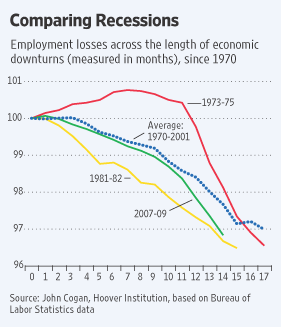
Ten years ago, the global economy was under stress, with few analists in the path of anticipating properly what it was a few week away(September 15,2018).The fall of Lehman Brothers, ignited the beginning of the worse economcic recession so far in this century. Beyond the events which followed that day , it is interesting to take a limited review about some factors which may give a clue about the origin of such extraordinary policy failure, because markets do not act either on its own or, outside the legal framework.But what may be worth to take a look into?
a.- Even considering the 2008 a policy failure, this conclusion does not come straight.This is so, because financial activities work on the basis of trust,reciprocity, and beliefs.For such a behavior, it is not only a matter of policy, but also about the underlying variables which influence the perception of uncertainty, which most of the financial activities work under.
b.- Whether it was not a policy failure, what was it?.An hipothesis is the so called "Implicit Guarantee", which is equivalent to a Central Banks in the shadow, as a lender of last resort. It is not real , but it may be ready to provide help to financial instituions when troubles about out of control uncertainty arises. Where this "Implicit Guarantee" comes from? .The "Implicit Guarantee" approach of economic and financial agents, arises from past experience, (What Central Banks did in similar past events), CEO Central Bankers preference about neutrality (Whether the policy approach is to allow market adjustment mostly by itself through expectations). This two variables,at that time, were on the side of boosting financial risk, than otherwise. Thus there was an " Implicit guarantee" and a preference for neutrality, which was equivalent to give a green light to higher level of financial risk. But none of them, dealt with economic policy by rather about perception. Markets operators and Banks, percieved that there was no limitation to push risk higher in investment porfolio.In fact , Banlks borrowed USD 30-40 of debt, for every dollar they had as Capital.-
c.- Regulation seems to be a critical variable to boost irrational exhuberance. However, regulation comes in place after the perception about the way the systenm cover further risk.In fact, the marketys operator , ask themselves how far the risk may go given a certain regulation which become a constraint whether it is low or high . Sure, lower regulation allow to go further on risk level, but the safety net to do that come from the "Implicit guarantee".Regulation allocate the kind of risk which are allow to perform within normal conditions of uncertainty, but not necessarily to solve the share of assets exposure to what economic agent percieved as uncertainty .One investor may invest in an heavy regulated investment funds , but if the market conditions get worse for all investors,their losses are not a regulation failure. In the 2008 crisis, the failure was more on the quaiity of the collateral to back up the face value of financial derivatives assets,after the economy start to adjust to the higher interest rates. It follows that , eventually a delay in such policy change, or a better coordination with the financial sector, may have gotten a different outcome .Regulation, seem to come next to those policy decisions.-
d.- Finally, the wealth losses in the household assets, for the private owner was in the range of USD 9,1 billion in the USA economy case, which is equivalent to a USD 35000 per familiy, almost 20% of the average cost for a new home at that time. The higher level of losses were on Wal street (USD 7,0 trillion bail out), and in the economy activity as a Whole (USD 12,8 trillion).This numbers suggest that the social cost of the 2008 crisis, were higher than private ones, even considering the fall out of benchmarking Banks at thast time.The explanation for this outcome, deals with the fact that private citizens has lower transaction cost than society as a whole, to organize a legal strategy of protection and defense for unexpected events. Unemployment , output losses , a zombie financial sector unable to boost economic activity , were all part of the huge social cost society could not protect from on its own, just like in any other economic crisis. This does not mean that it is desirable to induce economic agent to push risk beyond the fundamental of ecoonomic stability, but when it comes to a economcic fall down, the worse prepared are those who regularly face lower levels of uncertainty , such that the probability of getting by surprise is higher.-
Tuesday, July 31, 2018
Symbolic economics
Since the mid eighties, it has been usual to follow both economic news and its trend no just exclusively accordnig to the data available, but also by the opinions and evaluations of economic analists who make their own intepretation of economic data, shaping this way both the markets expectations and the investors mood which at the end get as an unexpected variable into the policy makers decision framework .So , what it comes to be at the core of any economic analysis is not necessarily the data itself, but either what his or her interpretation make of it.This is a source of power for all of those (analists , researchers and the like), who work within the scope of reaching public opinion about economics performance . It includes not only economic analists and their background, but also all those subjective subject related to the public percepcion, such as personal image, prestige, status,knowledge and culture attached to someone. All of these are symbols and its endowment have market value specially valuable when it comes to influence public perception.Thus, investors or for this matter ,public opinion will both listen and later follow what these people says upon the basis of their prestige, good image, knowledege, which are the envelope of the accuracy of their judgement.That is also the case of CEO of Central Banks. They talk, and market listen.
The importance of these flow of analisis and expert opinions,is that it reduces transaction cost arising from uncertainty and information assymetry.Of course, this is the case when these analisis are precise and both market and policy makers really cares about the "opinion side" of economic performance.After all ,anyone may have its own ability to
make their own decision instead of external advisers. It is well known in the case of economists, that when two of them try to solve a problem, it arise an aditional one. In other word,, two economists given their opinion abut the trend of any economcy,they may come to conclude either that it goes at different pace but the same direction , or even opposite direction whether they chose alternatives perspective (either investment or consumption)for the analisis. This does not means that economist are the less qualified to communicate what they understand better than others, but it is true that after 2008 many of them became under negative evaluation because they were unable to anticipate properly what was the underlying forces of that crisis. On july of 2008,some of them were certain that the economy was on the track of steady economic expansion. On the other side, just a few of them (two or maybe three), who correctly anticipated the crisis and in some cases were treated unfairly,did not get the attetion to their warnings. Some bankers, policy makers and researchers, wanted to believe what they thought it was worth to believe .The fact is that to cope with the effect of that crisis, the FED started what it was called the "Forward guidance policy" (2008-2017),which was the equivalent of the light in the darkness.
So any analists opinion, depends both of the quality of her or his assesment, but they also crutially depend of investors and policy makers ready to listen what they are trying to communicate . However, in a world of uncertainty and complexity , with unreliable prediction models, expectations have a key role for decisions making , such that those analists who make thing easier to understand, have the advantage of being able to make the proper interpretation of what is the meaning of any economic variable performance. So, market will follow them.-
Thus, the economy has two fields of performing, the effective arising from data, and the symbolic one arising from interpretation, and trend analisis. Both may be complementary to one another when the economy goes up, but either when it comes down or it is close to it, the situation become more difficult to evaluate because of the variety of factors taking place in such a scenario. So, Economists become like politicians , as Winston Churchill once said, they have to explain why things were in the opposite direction to the one they predicted.
Both, the effective and the symbolic one, make what a successful economy look like. How come ?. Well it is not only of matter of being well, but also a matter of being percieved well, and even much better.- .-
Saturday, June 30, 2018
Migration as a source of human capital
Perhaps one of the most conflicting issues of the global economy these days, based upon free flow of capital ,goods, services and labor, is the one related to migration. This is so, because as capital moves quickly to different places following the expectation of increasing profits, it requires both complementary services and labor skills to keep the economic return curve , as much as it is possible, on the rising side, otherwise capital will move to a new gains opportunity , leaving behind the adjustment cost of resources reallocation within sectors which loose capital , with those ones which gain capital flows. This mean that in terms of capital financial return in the destiny country, labor skills which matter the most, are the one above average. In other words , capital expected financial return, define the profile of labor migration needs,as much as those skills mean higher productivity. Of course, a different story is related to cost gains, but in this case it is capital which follow such a places.-
So, any economy lacking sufficient domestic labor force skills, may import it from other countries.It is like importing either education or qualified human capital. This was the story of Brain migration in the sixties from underdevelopment countries to development ones.-
However, Migration can be analyzed both from the demand(above), or the supply side.
The supply side of migration depends upon expected wages gains, coupled with the expected probability of employment(Todaro ,1981). Both, the higher the expected wage, and the employment probability , the higher will be the qualified migrants flows from one place to another.In this case, Migration is also an Human capital investment, which increases the returns of education.In such scenario, the migrant market fit the requirement of capital increasing returns.However,there are in place two implicit assumtions :
a.- From the productivity level that any competitive economy requires, the relevant migration flows are those endowed with high human capital levels, because even whether the probability of employment is low, such an important human capital endowment , allows their owners for higher flexibility, mobility and adaptation to different requirement arising in the labor search process.-
b.- The only way human capital arising from migration, may be useful for productive purposes (both increasing return of capital and employment), is based on the clear definitions of its property right. This has two tier:
b.1 Those propety rights, come from formal education and its certification granted to those who successfully get the finish line at whatever level.-
b.2 Those property rights, are recognized by the legal system of both countries( the one from the origin, and the one of the destiny of any migrant), which means that any migrant, must follow the rules of the legal system.
Thus, there is a formal markets of migrants, which like any markets may work well,adjusting its wage levels according to migrants flows. Given symmetric information, if expected wages are high because both , there is in the destiny country, strong economic growth and low unemployment level, it will increase the flow of legal migrants, which sooner than later will decrease the expectation wages and migrant flow wuill decline.To avoid such disturbing fluctuations, and its displacement consequences, Europe implemented a few years ago ,the "Guest worker program" which allowed Migrants to stay in the dstiny country for the period of time their labor contract allowed them to do so.-
But, the problem starts with the fact that the demand and supply flows of migrant do not always match an equilibrium in which social(private) benefits and cost are equal, becasue there is simultaneously an informal markets.
So, Migrant markets is a segmented one. with two categories:.
a.- The first level has the best of high qualified migrant
b.- The secondary level, has the lower qualified migrant which lacks of property rights,(not education certification), and do not have the incentive to get into the legal system, because it would valued it at zero .-
This secondary market, is the one which deal with illegal migration, equivalent to importing (country of destiny)or, exporting poverty(country of origin ). At this point, arises negative externalities dealing with poor migrants and poverty exporting, such as human traficking, border services requirement(patrolling, cheking point and the likes), aditional shelter for those in the waiting list, judiciary courts to solve those issues concerning the rights of the migrants, better unfrastructure to cope with health, sanitary and foods demands.
In this secondary market, social cost are higher than social benefits, while private cost(nothing left behind), are lower than expected private benefits(illegal jobs).So the outcome is that migrant flows are higher than what is socially needed.-
What is the proper solution?.The economic analysis suggest that any informal markets do not add up to social welfare. Instead, it decreases social welfare of the country of destiny, and no welfare gains whatsoever, in the country of origin unless, there are laws which may deal this disequilibrium. The law solves what market forces, do not, just the same way as it happens with environment contamination , collusive behavior in oligopoly markets,public goods, and the likes.The aplication of the resources provided by the legal system, is a guarantee for the property right protection and the welfare levels, of the majority of migrants.-
Economic analysis (Coase Theorme),also suggest that in some cases, there is a chance of political solutions based upon negotiations .But the Coase Theorem also make clear that such a solution, requires low transaction cost, and clear definitions of property right.However, none of theses condtions, apply to illegal migrants.-
So there are currently hard times for the global economy, because its global markets (goods, services, capital and labor) no always work the way it should. It seems that it is needed an up dated in the global economy institutional framework, dealing with the way markets provide even better outcomes than the ones which are already known.-
Thursday, May 31, 2018
Women´s Labor force participation
When it comes to consider women in the labor force , the outcome is clear. There is a widespread dispersion between countries with high and those with low women ´s labor participation force. It is high in the lowest and highest income countries alike , and it is low in those countries in the middle income levels. The reasons to explain this situation goes as far as cultural factors, educational levels, wage discrimination and lack of a proper legal status to protect women on the job,specially when they have families to care which led them to informal labor market,and weak labor conditions.-
The labor force participation rate, is the proportion of the population age 15+ who is economically active The trend ,since 1980 ,has been an increase in the women´s labor force participation rate ,although at a different pace , getting in the range of 50-60% in countries like USA, Germany Canada ,UK. and Spain. Latin America and the Caribean is also in the range of 50%.-
From the economic stand point, most women need relative higher wage rate to get into the labor force than men,because her marginal disutility of working ( to delay maternity for instance), is higher such that they need a better and higher compensation, but at the same time, their time span expectation of staying within the labor force, is shorter than men, which imply a downward pressure on their wage level over time which measn that their net wage trend leave them earning less than mens .It follows that for many women part time jobs , adaptable schedules or net working , fit quite well with their preferences, Of course the real issue should deal with their abilities and skills for jobs performance, but the empirical evidence do not seems to take these variables aside from the ones mentioned above.The case of Denmark is an example where women earn less because of having children no matter their age (Ortiz-Ospina & Tzvetkova, Working Women Key facts and trends in femmale labor force participation ,2017).-
Beyond the causes , determinants and explanations, the change in female labor force participation have quite important side effect:
a.-It foster the development of the services sector.-
b.-It facilitates new alternatives for net working
c.-It support adaptable labor schedules, which improve flexibility conditions on the labor force
d.-In some specific sectors ( driving heavy machinery equipment in mining activities ) are more productive than men,measured by the period of time keeping the working operation of the equippoment, which is longer than the case of men.-
e.- In other areas women have better comunication skills specially suitable in the for movil phone calls areas to promote commercial packs .-
f.- Women CEO, make a difference when it comes to use intuiton, emotional connection(closeness) to drive a team toward its goals
Thus, there are a lot of reasons to expect more women into the labor force in the years to come.More so, when some emprirical evidence (World Bank, 2018). indicates that there are productivity gains associated to women on the economic activities.
Public programs designed to support women on maternity age, and firms policies to protect women on the job , are more than compensated by the gains in value added and productivity for the economy as a whole.-
Monday, April 30, 2018
Is Latin America turning to the right?
It has been the case that the latest Presidential election in Latin America, has concluded with new elected Governments which had a political platform based upon ideas like free market, freedom of enterprise, better state to cope with social disequilibriums,specially those related to inequality, poverty and discrimination.-
The underlying foundation of these outcomes, deal with the fact that there is strong disapointment with the Government failure to provide what the new middle class expect,(good quality jobs, services, education and health ),and skepticism about its ability to make a turn around such as to be a partner for the expectations of the majority of citizens.Instead , the politcal spectrum has been involved in scandals of a variety of situations, the most devastating of them all, have been the corruption charges against those who had become leaders, to consolidate the social achievements.-
What are the implications of this movement to the right ,and may it last?
a.- First of all, it is important to make clear that the citizens are looking for different solutions to new problems.This means , there is no way that old solutions will work .So it is the time of change and transformation. Change because of shifting roles from Government to both firms , and the civil society empowered by social networks.Transformation because economic growth has some limitations to deal with.Strong institutions are the key to make economic development an achievable goal.Both better instituions and the proper incentives to economic growth, are the golden mix to follow through.-
b.- The private firms has made a contribution throughout the Latin America economies, to validate the role of markets to provide jobs, commercial credit to make afordable more durable goods, and by extension better standard of leaving.Besides, the initiatives of integration has made clear the relevance of private investment when it comes to give opportunities of new jobs, and take advantage of markets expansion.There is not doubt that the consolidation of private firms as the real partner of progress and well being of latin american citizens, is also a key explanation of voters to prefer market solutions.-
c.- Trust is an asset hard to get, but easy to lose. Unfortunately , there is not many institution to trust in Latin America , with the exeption of those linked to citizens´ s own interest ,such as some NGO, and Networks with the skills to be the echo of those issues the society care the most. It is a surpiring fact that the state and society has moved away from each other, because those whose role is to be the intermediaries (political organizations), also failured to be up to the job. In the last fifteen years or so,political organizations turned out to be on the state side,to protect its failures, instead of focusing on how to solve society expetations .They were part of a machine not to serve the citizens ´s interest, but to serve their owns. For this purpose, the state was captured by small groups strong enough to change the course from where it should belong and stay.-
d.- From the above it follows that freedom it is not a slogan, but a real chance of living up to its possibilities and opportunities.It is a better chance than Government promises which make fool of those who believe them.The new middle class is keen to realize that to improving steadily its living standard , falses promises are not what they expect and deserve. More so, freedom has become a more realiable alternative than government to provide justice and social equilibriums.Those countries in Latin America based upon the value of freedom are better off than those which still believe in Government.-
Finally. is it possible that this change will it last?.After all, there are still political elections under way on the landscape, which may be a set back for all theses arguments.There is no easy answer.Each political process has its own profile which make it hard to extrapolate mechanically to any political event, and even to all up coming elections. What matter the most, is the trend and its underlying forces, it may take more or less time for the majority of countries in Latin America to be on the line of shared prosperity,integrated to the global economy as a reliable partner, but the seed is already in place.From now on,It is more the responsibility of those leaders from the right to follow the best path to achieve those goal .-
Saturday, March 31, 2018
Industrial revolution 4.0
Since 2010 the global economy, has been working steadily to implement more advanced stages of digitalization.The digital productive process started to be an issue which to give attention , in some business in Germany when they were looking ten years ahead and realized that internet would not be just an information -Knowledge device.The internet of thing (IOT), and the artificial intelligence as a powerful complement to manage information, were on the path to become key variables to support new approaches to production process , chain value creation , customer relation management and big data processing, all of which create a new environment for CEO decisions making process, global connectivity ,automatization ,and the ability to get deeper into costumer feelings (Biometrics analysis).-
However, this revolution, the so called 4.0 one, begun more than 35 years ago when the japanese started to work with more advanced computer (intelligent computer) which set the first step for robotization and later to "human like- robots", which make the whole necessary scenario for the firm fully robotized to become a reality sooner than expected.-
So, business Management is under a new challenge, the one which arise from the possibility that the whole productive, process may be done by intelligent machines able to learn by themselves, to make fast corrections and data evaluation.CEO will have to work harder in the data analysis phase of the productive chain, improving its qualification to take advantage of their different sources of capital , arising from networks, big data accumulation , and talented people, to cope with the faster adjustment demands aimed to more sophisticated consumers.The value creation will also be revisited as long as integration will include not only specific productive process of one firm , but also different but connected firms such Banks, insurance firms, different components in the auto industry and so on.-
Latin America is not away from this revolution .There are some research which indicates that by 2021 , 40% of its GDP will be in a digital format, and 40% of those more important business , will have a complete technological platform.-
The next question is how Government will handle this change?.How will it impact on its own nature?.Is it possible a digital government?, If it is so, what are the implications about a Government with limited human control?, or a Government which become just another part of digital business?.It seems that few traditional government services, will survive the digitalization era, such that those which may actually be done by internet(all kind of certificates, tax payment, and the like), and only the real new needs will be justified, among these (cyberspace security,and data protection ).Welfare level will depend more on the business ability to get higher productivity, than traditional government based on a service supply role.-
Wednesday, February 28, 2018
The global economy adjustment path
The global economy is on its way to get "normal".This means all prices become fully in charge of every markets.Interest rate like others prices (Wage,exchange rate, and goods) are increasingly reflecting the effect of the so far steady economic global economic expansion. There are risks along the way such as overheating, asset overprices and market volatility, as prices start to moving to its long term path.
The economic cycle at a global scale is in motion. As economic growth get traction, it stress up labor market and wages, which add up to the firms cost, and so to its good prices. Thus the expected inflation increases and the Central Banks comes along to get in charge of the prices adjustment, to make it as soft as it is possible. This is the conventional approach.
However, the global economcy and its broad and deep links both real and financial ones, make things a bit more complicated.
a.- The missing variable :Productivity, may be higher than conventional statistical measures (out per man/ hour) are considering. Information and ideas flows, conectivity speed, faster data processing, plus knowledge sharing, and global innovation chains, make productivity higher than its limited quantitative measure. It also has a qualitative component.In other words , value become as an important part of productivity gains.-
b.- It follow that wages may goes up, but as long as the whole productivity also goes up, inflation may be more stable than expected even whether agregate demand keep its upward trend. Alternativeky, inflation may take more time to get its targeted level (2%), and overheating in the short run may have a lower probability.
c.-The financial side, is the other variable in the global economy expansion. Given its fundamental, asset prices may be higher than its real value, fostering private debts level to the higher risk zone, both in case of a sharp downward movement in agregate demand, and with the increasing probability of downward price correction, along the reinforced market anxiety related to it. Exchange rates take its share of the portfolio adjustment , some currency moving downward ,while others moving upward. Expectations may deteriorate and all of the sudden the global economy moves from expansion to a "stand by" mode, if not contraction, while the adjustment take place.
It follows that interest rate has two transmission channels: both the real(consumption and investment levels), and the financial one(asset prices and portfolio allocation).-
Current data are not conclusive about the global inflation trends.It is close to its target level (USA), and half its target (Euro zone), but it is still not a fact that the target is about to be surpassed, given that december ,january and february ,are usual months with higher demand for energy intensive goods and services, the ones with more prices increases in december 2017.
So what may be expected?.Interest rate will be the latest prices to be adjusted along this year, following a path suitable to the new developments on the real side, (higher productivity than the one which is measured),and the deeper global financial links which make the financial transmission channels to work faster.
Subscribe to:
Posts (Atom)


